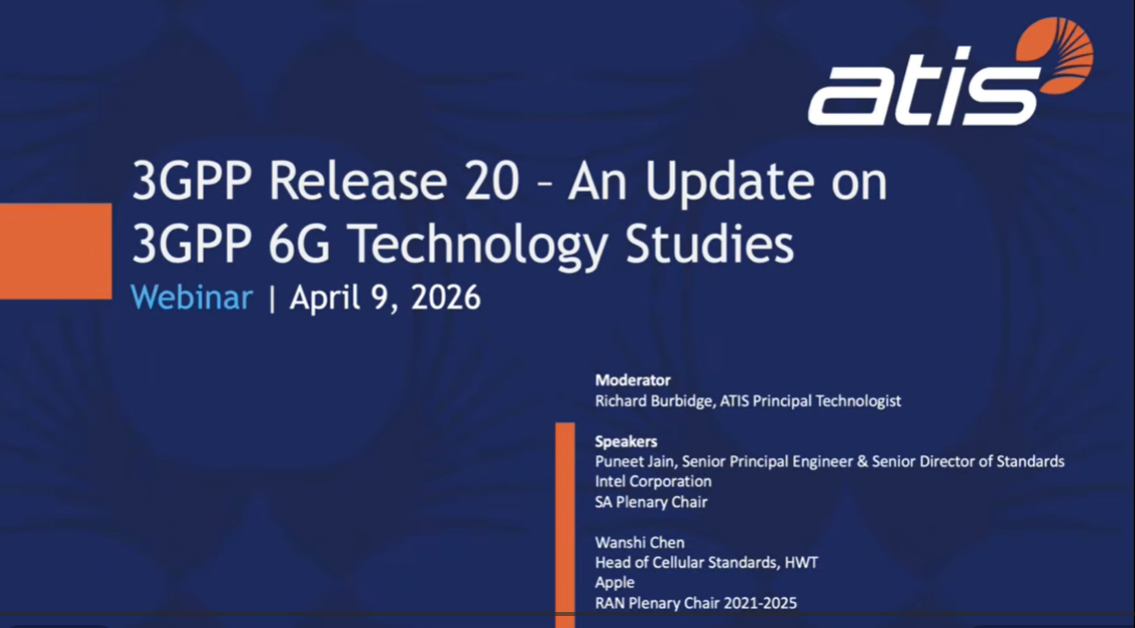
The ATIS Webinar is well worth a watch. Three experts; Richard Burbidge (Principal Technologist, ATIS), Puneet Jain (Sr. Principal Engineer - Technical Standards Intel, Chair of 3GPP TSG SA) and Wanshi Chen (Head of Cellular Standards, HWT, Apple, Former Chair of 3GPP TSG RAN) took us through what they already know about 3GPP Release 20 - 6G Technology Studies.
First up was Puneet Jain, TSG SA Chair. He focused on the maturity of 6G requirement gathering and the progress on the architectural framework for it. He also stressed that the timing of each stage has become vitally important as a strict schedule emerges for the 6G standards making process.
The importance of Rel-20, with its two distinct components was stressed (5G Advanced study & normative work and 6G studies) as Rel-20 is set to be the one that ensures the smooth transition from 5G-A and 6G. Puneet Jain said "This dual approach allows us to continue enhancing 5G while simultaneously laying the rigorous groundwork of 6G and providing vital market stability along that path."
Rel-19 was completed in December 2025, at TSGs#110 hosted in Baltimore. Since then, Rel-20 work has progressed well along its 18 month span. The TSG SA Chair took the webinar audience through the stages of the latest 3GPP Releases.
- Rel-20 Stage 1 was frozen in June 2025 (TSGs#108). Stage 2 is now the focus in the groups & is set to reach 80% completion in June 2026 (TSGs#112) and is set for September 2026 (TSGs#113) completion.
- The all-important Rel-20 Stage 3 functional freeze is therefore on schedule for March 2027 (TSGs#115) - with ASN.1 and open API coding to be completed in the three months after the March plenaries.
Puneet Jain told the webinar viewers: "This predictable cadence is critical for industry planning and research coordination as well as a trusted mechanism to ensure that 5G Advanced continues to evolve as a structural foundation for the 6G... I'm very pleased to announce that that the 3GPP SA1 6G study on service requirements is now complete. TR22.870 clearly demonstrates that the industry is creating an intelligent, sensing capable and operationally robust 6G network architecture."
Highlight: Ten minutes into the webinar, Puneet digs deeper into details of the WG SA1 work on TR22.870.
How Rel-20 is handled in TSG SA:
- WG SA1 Service Requirements - Stage 1 frozen June 2025.
- WG SA2 System Architecture & WG SA6 APP Enablement - Progressing well towards September 2026 (TSGs#113) Stage 2 completion.
- WG SA3 Security and Privacy, WG SA4 Multimedia & WG SA5 O&M and Charging - Handle both Stage 2 and Stage 3 for their areas.
TSG SA and 6G
Puneet Jain then covered the 6G progress in the group. He noted that 3GPP 6G journey began with a WG SA1 led Stage 1 Workshop in Rotterdam in May 2024. He commented: "This was the first time when 3GPP brought together broad ecosystem of Operators, Vendors, Research alliances and the vertical industries to discuss 6G use cases and scenarios."
In March 2025, a 3GPP-wide 6G workshop was held in Incheon, with over 1600 attendees, providing a pivot in setting directions for both TSG SA and TSG RAN working groups acting as a guide to the 6G technical studies that follow.
These studies will form the basis for Rel-21 normative work. The timeline for Rel-21 is under discussion and expected to be finalized in June 2026 (during TSGs#112).
To end, Puneet Jain observed that with Rel-20 3GPP is successfully executing a dual track approach - aggressively pushing 5G advanced novel work while accelerating our 6G studies.
Radio Access Networks beyond Rel-19
Wanshi Chen is a recent past TSG RAN Chair and former Chair of WG RAN1, the group responsible for the physical layer specifications.
During his presentation, he first covered some Rel-19 topics: Briefly covering the 11 WG RAN1 projects and 8 WG RAN2 (Layer 2 and 3) projects in the release (from 28:30 in the video).
Details from the Rel-19 and Rel-20 projects listed in the presentation:
| Rel-19 in RAN1 |
| AI/ML for NR Interface |
| MIMO Ph.5 |
| Network energy savings |
| Low-power wake-up signal and receiver for NR |
| Evolution of NR duplex operation: Sub-band full duplex |
| Ambient IoT |
| Multi-carrier enhancements Ph.3 |
| IoT-NTN TDD mode |
| LTE based 5G |
| ISAC for NR (Channel modelling) |
| 7-24GHz for NR (Channel modelling) |
| Rel-19 RAN2 |
| NR mobility Ph.4 |
| NR NTN Ph.3 |
| IoT-NTN Ph.3 |
| E-UTRAN TN to NR NTN |
| eXtended Reality for NR Ph.3 |
| BeiDou Navigation Satellite System (BDS) A-GNSS support |
| NavIC (India) A-GNSS support |
| NR sidelink multi-hop relay |
| Rel-19 RAN3 |
| AI/ML for NG-RAN |
| Topological enh. for NR |
| SON/Minimization of Drive Tests in NR and Multi-Radio Dual Connectivity Ph.4 |
| Rel-19 RAN4 |
| NR Radio Resource Management (RRM) Ph.5 |
| UE RF |
| BS RF |
| Low band Carrier Aggregation via switching |
| UE Demod Ph.5 |
| 5 MHz FR1 Ph.2 |
| NR ATG |
| NR Sidelink |
| NR NTN and IoT NTN |
| TRP/TRS Ph.3 |
| EN-DC/NR-CA deployment Ph.2 |
| Rel-20 RAN1 |
| Solutions for Ambient IoT in NR Ph.2 |
| AIML for NR air interface Ph.2 |
| NR MIMO Ph.6 |
| NR Coverage Ph.3 |
| Rel-20 RAN2 |
| E-UTRA TN to NR NTN handover enh. |
| NTN for IoT Ph.4 |
| AI/ML for mobility in NR |
| NR Mobility Ph.5 |
| XR for NR Ph.4 |
| Rel-20 RAN3 |
| AI/ML for NG-RAN Ph.3 |
| Data collection for SON/MDT in NR Ph.5 |
| Rel-20 RAN4 |
| NR Radio Resource Management (RRM), Ph.6 |
| UE RF |
| BS RF |
| LBCA via Switching |
| UE Demod Ph.6 |
| NR NTN and IoT NTN |
| OTA |
| UAV |
NB: Wanshi Chen told the webinar audience that the above projects may be subject to necessary adjustments.
6G to be 'Lean'
One of the key decisions by the RAN community, endorsed at the PCG level (Highest 3GPP coordination group) is that 3GPP is "to create lean and streamlined standards for 6G, e.g., by dimensioning an appropriate set of functionalities, minimizing the adoption of multiple options for the same functionality, avoiding excessive configurations, etc. Any exception to the above shall be well justified."
First 6G RAN Studies
Wanshi Chen outlined the 6G study milestones, in alignment with the first Rel-20 RAN Plenary 6G study: 6G Scenarios and Requirements (TR 38.914).
RAN has established intrim 6G checkpoints for TSG RAN#112 in June, Singapore. RAN1 will provide their assessment of physical layer work on waveform, modulation, channel coding, channel bandwidth, frame structure, numerology, basic signal structure along with the periodicity.
In RAN3 they aim to have study results for TSG level decisions on the 6G RAN to Core Network interface (P2P vs SBI) and on RAN interfaces (CU-DU split, CP-UP split), both in time for the agreement at June Plenary on the Rel-21 timeline (Freeze dates).
By September, during the TSGs#113, Madrid, TSG RAN will make a decision on further migration (to 6G) options - In addition to Standalone 6G, Multi-RAT spectrum sharing (MRSS) and Inter-RAT mobility between NR and 6GR (more on this in slide 38 at 36:50). Wanshi Chen advised that this [September decision] includes the decision on "6G-6G aggregation beyond 6G CA".
Highlight: The improvements expected in RAN KPIs from IMT-2020 (5G) to IMT-2030 (6G) are covered in the middle section of the webinar (See 33:30 - 35:24). Wanshi Chen observed that for 3GPP 6G TSG RAN work for IMT-2030: "Overall, all of these [improvement] numbers are much more realistic. Instead of pushing the envelope, we are focusing on something more meaningful."
One important aspect for study is the diversity of 6G device types (See slide 37 at 35:30). In 5G, we started with eMBB and URLCC and introduced other device types later on. From the start of 6G, TSG RAN will accommodate diverse device types, but it is not yet clear whether RAN and its Working Groups will explicitly define specific device types in Rel-21 or leave space for a broader categorization of devices. This is one to watch.
Wanshi also covered (37:45 - 45:55):
- 6G Services: Design for eMBB, 6G Massive IoT, Service awareness, Sensing modes, etc.
- Key Physical Layer Features: UE Channel Bandwidth, Waveform, Modulation, Coding, Numerology & Frame structure.
- Coverage and Energy Efficiency
- AI/ML 6G Study: AI for RAN, RAN for AI. Includng how to downsize the Use cases identified?
- Sensing Study in 6G: Not yet started, but two tracks envisaged: Sensing assisted Comms and Sensing specific use cases.
...and some other important areas (final slide).
The two presentations were followed by a Q&A session (46:30 - End).
About ATIS:
The Alliance for Telecommunications Industry Solutions (ATIS) brings together the top global ICT companies to advance the industry’s business priorities. ATIS is the North American Organizational Partner for 3GPP, a member of the International Telecommunication Union (ITU), as well as a member of the Inter-American Telecommunication Commission (CITEL).
visit www.atis.org
 3GPP News